Wednesday, April 7, 2010

I should re-name this blog a “A bad dream into reality”


This blog documents the continuing ups and downs of a chosen lifestyle in Sri Lanka with particular reference to living in a rural area as opposed to urban, and attempting to farm one’s land, grow as much as possible to satisfy the desires of the consumers to whom I sell everything I grow. The most important goal was to achieve self sufficiency and have a surplus in order to release myself from being tethered to other work to subsidize my losses. I have been doing this for over 5 years and am being pressed both by readers and friends and family to give it all up get a nine to five job and live a life of luxury in Colombo, marry a wealthy socialite of which there are many waiting just to be asked, and give up this ghost.

While I still live in hope, I have singularly failed to break-even. I have no financial resources to fall back on, so I have to do other work to continue this venture and literally live a hand to mouth existence, in case my readers were wondering why I was cutting the paddy this last week. Just today, as I was doing another job, I was told that the paddy that was cut yesterday, (as you see in the previous blog entry photo, lying on the field before they are collected) was actually stolen overnight from the fields themselves. It is reflective of the rule of law in this country, where there is no justice for the average person, due to the grave injustices carried out by the elected officials, which prompt people to take the law into their own hands, knowing that they will not be caught, prosecuted, let alone punished.


I drove through the night from Colombo, after a day’s work, back to my property in Minneriya, only to find it empty. The gates were open, but my man in charge was missing. There was no sign of him and I could not wake the neighbors in the middle of the night, so I had to find a match, light a Godakumbura bottle lamp, eat the rice packet I picked up on the way, make the bed in the verandah and sleep.

The next day, I discover the man had left two days previously, leaving the keys with the neighbor, because I had scolded him for not organizing the paddy cutting as I had instructed before my earlier departure. He had pawned the phone I had given him, and had used the money to drink, and borrowed the money to go home.

Faced with this sudden turn of events, I had no option, but to immediately start the paddy harvesting, as it had already passed the due date, and a spell of rain in the intervening period had meant the paddy had all fallen, and in the muddy fields already ruined as it had got underwater, as can be seen from the photo here. The crop damage arising from this is substantial over and above the theft I alluded to.

In reality these fields if my instructions were followed and cut when they should have would have yielded an envious harvest as the neighbors said they had never seen these fields so heavy with paddy kernels, a reason for the falling with the rain.

Tuesday, April 6, 2010

The style and art of paddy harvesting with a scythe, soon to be forgotten


Paddy harvesting is done twice a year for each of the harvesting seasons on paddy land. It was the case in the past when the whole family participated in this, and one leaves the home after a big breakfast as much energy is used in the day’s activity.

There are songs, dances and traditions related to this activity. Now however with increasing cost of labor and lack of labor, it is the turn of the harvester to do this. Due the fields that I had to harvest, being too wet and muddy, I had to use manual labor the most expensive alternative to harvest these fields. The daily labor rate is Rs750 plus morning tea with a bun, lunch and afternoon tea with another sweet food item. Due to the severe shortage of workers and the seasonality of the work, this puts a premium on the labor at this time of year as a lot of paddy needs to be cut and there is no one willing and able to do so, in an increasingly affluent or lazy country depending on the outlook you may have to the Sri Lanka of today.

You take whomsoever you can find, and whether they are good or bad the rate is the same, a very anachronistic system, which is partly to blame for the low productivity of the workforce. Contract work is now the preferred route due to the labor shortage. People come to the area from other areas to cut the paddy, and they charge Rs8,000 an acre to cut and bundle and carry the bundles to the place where the mechanical thresher is used to thresh the cut straw into paddy.

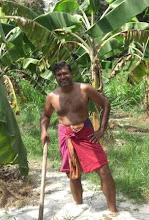
I am late into this line of work, but last Friday, Saturday and Sunday, (yes that is Good Friday to Easter Sunday) while others are either at church or enjoying a break from work, I was reduced to cutting the fallen paddy in much the same way as is shown in the pictures, as well as enjoying the much needed calories refreshment to carry out the work. While the paid labor start at 8 and finish at 5 with 90minutes for lunch and 15 minutes each for the morning and afternoon break, it was no such luck for me as it was from dawn to dusk.

I am alive to tell the tale nursing swollen blisters and muscle aching pains, one wonders in these circumstances about the people sweating away in air conditioned gyms in urban centers, trying to get the same work out but with less longer lasting pain. It is in these times you appreciate the manual work people do, but also realize the utmost importance to find labor saving solutions to each of these problems as it is the way of the future, both in terms of productivity and cost reduction.

If I may make one observation from my area in Polonnaruwa, I did not see any women dong this job, as they used to in the past. No wonder they are so fat in comparison to the wafer thin men, scrawny out of alcoholism and manual work.

Monday, March 29, 2010

the western road north hugging the west coast will be complete to Jaffna


The current state of the bridge construction at this crossing of the Aruvi Aru just south of Mannar.

I went up the Western Road, now open to the public from Colombo, via Puttalam. From there on the road, some parts of which are paved and others dirt, were nevertheless being widened and improved. We passed Vanathavillu, and then nr Eluvankulam we crossed the Kala Oya at which point you enter the Willpattu Park and continuing on this ver dusty trail, we crossed Moderagam Aru at Mullikulum where you leave the park.

You then enter a buffer zone which is now gradually being occupied by farmers who wish to make use of a number of abandoned tanks for paddy cultivation. Continuing on to the next area of revitalized settlements at Sylavaththurai one sees a lot of paddy cultivation and at this time of year much harvesting with combine harvesters of the largest kind.

Just North of here the main road turns inland and though i did not go on it , was told it is being carpeted to a high standard. This road meets the Medawachchiya Mannar Road nr Murunkan which is the current route to Mannar.

We however continued along the coast and hit Arippu where the previous blog entry at the Portugese Fort was described. Shortly thereafter the road was closed to 3 wheel and above, where it meets the Malwatu Oya. At this point the river is called Aruvi Aru. There used to be a ferry service here. A proper bridge is being built now and at present only bicycles and motor bikes ply the route with people going to Mannar to work as it apparently saves about 20km of the distance.

It is only a matter of time after this bridge is built, that the A32 Mannar Pooneryn road is completed and tarred or carperted. One then can go all the way to Jaffna on this route, shaving 100km from the whole distance.

While environmentlalists may frown on this further race to build new roads, this opens up this vast currently sparsely developed area for development. My only concern is that this too will be carved up into small settlements and our manic desire for land is fulfilled, instead of the more productive and profitable, large extended farms or estates where crops can be grown, along with adequate reservations made for National Forests and areas that are demarcated as virgin lands not to be encroached upon. My point is as evidenced in my area, lands given to small farmers eventually get subdivided and become homesteads creating a country of villas and not productive agriculture.

Before any allocation of lands it is important that a national policy be adopted with regard to opening up lands. and strictly adhered to. I am afraid once the horse has bolted the enviros and others will try to close the stable door. So before it is upon us do something now as we always wait till its too late to try and reverse decisions, without first evaluating the decisions at the time they are made. People complain they are made in secret, but there are ways to find out impeding decisions if one is on the ball.


Aruvi Aru shortly before it flows into the sea just south of Mannar

Friday, March 26, 2010

a Portuguese two bastioned fort at Arippo


Going due North of Sylvathurai and the new settlements of the Western Coast past some hidden coves where the LTTE used to bring ashore and bury arms until they could be retrieved and transported accross, are signs of new life of small communities, possibly the return of displaced people back to their original villages. In the midst of one was this old abandoned Portuguese Fort, which presumably even the Archeological Department cannot determine if it is worth enclosing and for the moment, preventing from encroachment of settlements.

One would not know what this was unless one alighted and read the board and just wondered what it would have been like in its hayday! I presume there are so many such places with history that have just been covered over, encroached upon and generally forgotten until and unless someone privately tries to publicise the plight and get the authorities involved. I presume this is also due to the lack of funds to fully manage the places of Archeological interest in this country. In America, I know some of these locations are purchased by people who using the site, bring it up to a standard for veiwing then charge a fee and manage to make a living from this, both preserving what remains, and also taking the cost on to themselves while also undoubtedly making it financially viable. We may eventually have no option but to take this course if we are to prevent many of the smaller lesser important sites from completely disappearing, for lack of resources.

This can be called sustainable exploitaiotn of places of interest that increase the leisure choices of a newly liberated populace massivly overcrowding the limited places of interest that are open to the public and therby reduce its attraction, to say nothing of the desecration from over use.


This fort above is a small two bastioned Fort originally built by the Portuguese and then taken over by the Dutch after the battle of Mannar in 1658. It was to this Dutch Fort incidentally that Robert Knox escaped in 1679 after his 20 year captivity in the Kandyan Kingdom. Governer North converted this Fort into a bungalow for his officers supervising the Pearl Fisheries, which later became the Rest House at Arippu.

The tombstone ( see photo below) is of Charles Leys, an employee of the Oriental Banks Corporation, who died of sunstroke at Marichchukaddi on while on a shooting expedition.


This flowers are from the tree I found at this fort and shown earlier in a separate blog entry on 23rd March 2010. So this is where it was photographed and I have still to get confirmation on the type of tree this is.


Dolphins and the Barr Reef off the coast of the Kalpitiya and Uchchimunai


January to April appear to be the months when the seas off the coast of the Kalpitiya peninsula are calm and the dolphins are at play a few hundred meters from the coast on the sea side. We were in place by around 7.30am due west from Alankudah about 500m into the sea when we spotted schools of dolphins swimming alongside the craft with us. My photographic attempts with a digital camera came to no avail, as the shutter somehow appears to delay from the time I pressed.
I have experience in seeing Dolphins and Blue Whales of the coast of Santa Barbara, in California, and there are strict guidelines about the number and size of vessels permitted for whale watching. This has led to minimal intrusion on the mammal and little chasing by a flotilla of craft as is found here. While I was on a larger craft, being able to look a long distance to spot them the smaller fishing boats that double up as Dolphin boats, while closer to the objects are nevertheless bereft of a clear sighting and therefore congregate once a boat has sightings and so speed to where they are, sometimes to the annoyance of the Dolphins who dive down only to emerge a distance away, to be chased yet again.


Whatever one says it is truly breathtaking to see 10 or more Dolphins swim together in perfect formation at close quarters and so close to the shore line. I understand that off the Southern Coast there is a long journey into the sea before they can be sighted. I am surprised that while they have been around for so long in this area that this activity is only now being exploited. Perhaps due to the security situation sea going craft were restricted and so this activity not permitted.
A more spectacular place just north of where these Dolphins were is the Barr Reef a section almost at the tip of the peninsula, I think called Uchchimunai, where there is a reef about 3 foot in depth, so the craft have to tread lightly, where there is live and dead coral and a sighting of different fish almost visible to the boat, but perfectly visible to snorkelers skimming the surface and not having to dive at all. If one can just float with snorkels one can just watch the proceedings down in the coral basin. While I was only in the shallow section, I presume there is a deeper section with a more varied selection of coral and fish.


The numerous islands are wonderful, some with beaches and others without, where there are fishing waadiyas and one I was shown as being the location of the Six Senses Resort, which to me looked a very dull island with no beaches. I personally don’t think that island should be developed as I cannot see much potential.

Thursday, March 25, 2010

kalpitiya lagoon at dawn with an unusual lighthouse


Sun rise on the lagoon


I was told that this was a lighthouse, but as it was a new building, I presume it is still not functional and wonder if it ever will be! Let me know if any of you are wiser to the fact.


The wake from the water jet and the sun rise as we go east from Puttlam at 6am.

Wednesday, March 24, 2010

“DORIC” The House of the first British Governor at Aripo, Sylvathurai some fascinating insights into the past which very few people are aware of


I visited the remains of a house, now long abandoned to the elements, of Frederick North the first British Governor built in 1804 to oversee the then most famous export of our Island, the Oyster Pearl from here where the Pearl Fisheries were. The House was supposed to be the most beautiful house in the Island at that time as it was a purpose built house completely designed in a style for in keeping with European architecture, but which was nevertheless the ultimate beach house!!

All European Royalty from then till now wear natural Pearls, white, black and pink that were collected from Oysters off Kondachchi Bay overlooking this house.

Some interesting observations are that the sea erosion has eaten into our landmass as there was probably at least 30meters of land from the house on top of the cliff to the sea. Now the remains are at the edge of the sea and in a few years what remains will also fall down the cliff into the water.

There are mother of pearl shells strewn all around, as a by-product of the Pearl Fisheries, and there no telling if that remains now what there would have been then. There would have been a thriving secondary industry using the mountains of oyster shells from which mother of pearl ornaments etc were made.

The sea shore as can be seen from the photos is straight with no beach, but one can walk a considerable distance into the water making it perfect at this time of year to bathe as there are no waves. Ideal bathing spot!! Of course no one uses it as we don’t normally bathe in the sea if it is at our back yard.

Just imagine the parties that the Governor would have thrown here at the height of the Pearl Fishing season. Details of which are described in a book by the Governor’s chaplain, Reverend James Cordiner’s Description of Ceylon 1807.
The divers were usually from South India and from Africa. There may have been Arab traders and traders from all over the world to purchase these valuable items.