Saturday, April 25, 2009

I voted and what I found inexplicable


My Voting card in Sinhala and Tamil only

I am registered currently for voting purposes in my farm in Godagama, which is in the Homagama electorate of the Colombo District. I had a list of 41 parties including independent groups with potentially 46 persons vying for preferences for each party.The ballot paper was about 2 ft long to accommodate all these parties, firstly the party sign on the left hand side box, and then the name of the party, in Sinhala, then in Tamil followed by English. In a small section in the bottom, a box of approximately 8cm X 6cm were the 46 boxes with numbers to cross for three candidates for the party one voted for in the top.

The irony was that most people know what party symbol they would vote for, but which of three numbers to cross is much more difficult. Peoples attention span for remembering numbers is not good, and though one may remember one number of a particular candidate, recalling three is a wholly different matter.

I was particularly shocked when my father who had voted in the Colombo West electorate and came up to the farm in the morning told me, that as far as the numbers were concerned he had no clue who he voted for, just crossing three consecutive numbers in boxes, as he did not know names or numbers of candidates.

If that is the comment of a supposedly experienced voter of numerous elections, then I can only conclude that this system is considerably flawed, as all the electioneering was to get people to remember names and numbers, and not party platforms, and even that was poorly executed.

The scale of the waste of money thus expended on an election, which for all intents and purposes is merely a referendum, is unpardonable in light of the current events. Effectively to me it is nothing more than a jobs list for the second tier of boys, who get a duty free vehicle, for all 104 provincial councilors elected. Not one word of utterance was made on how the Rs50B allocation for the Western Provincial Council will be spent. No surprise therefore that voter turnout was under 60%

I found one troubling point which I would like one of my readers to explain. My ballot paper was torn from the perforation and given to me, and my voter number was entered on the counterfoil.Now the counterfoil and the ballot paper have a unique number much like in a cheque book where the counterfoil and cheque have the same number. It is therefore possible, and if computerized, very easy to match who voted for which candidates and party, nullifying the whole point of a secret ballot.

I would like some clarification on this, as to why the lady handing me the ballot paper wrote my voting card number on the counterfoil in pencil!

Thursday, April 23, 2009

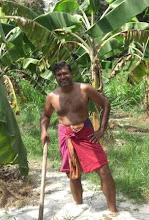
This chap betters my delivery range!!


The man in the photo came the other day to my home from whom I bought a host of cleaning implements. I really admire his industriousness as well as the convenience to the customer. I wish him well, a true Sri Lankan worker.

Wednesday, April 15, 2009

Dream into Reality – the “Wattle and Daub Hut”


A month before my graduation from the University of Bristol, (no 32 in the latest world league table of Universities) with an honors degree in Economics and Accounting, I celebrated my 21st birthday. The couple, who took me to dinner that day at a restaurant by the Downs wanted to know what my future aspirations were! Half jokingly I said I would like to live in a mud hut in Sri Lanka, free of all the troubles and stresses of western life.

Part of this prophecy is now coming true, and I hope to get some photos to straddle this entry to show the construction phase of the hut. I am not kidding but it is the coolest place on the planet! The sticks and wood used to make the frame have been cut from the area about the property, with no harm to the environment as thinning the branches will help the trees grow better. The mud used to fill the crevices is adjoining the hut, from an anthill, the traditional source for good quality mud for this type of work. The roof is covered completely in Iluk, as this will last for about 5 years, and is strong and plentiful.

The construction was done by the local people, with the young looking in awe at its construction, as I don’t think this type of hut has been constructed in these places for a long time, and is also a tradition that is fast dying as almost all homes are now made of brick and cement, with roofs either of sheets or with tiles. It is interesting how the mud balls made much like for a pottery class are blasted into the crevice by hand to stick, and then the mud has to dry before the outer layers are put both for the inside and the outside.

The hut comprises a room 13ft by 10ft and a verandah, 13ft by 5ft constructed under a large tree to give it additional shade and coolness. The pictures show the simple design, and I hope to have two single beds in the room with two chairs in the verandah and a book-shelf. A basic traditional door and two windows facing the verandah are included together with two 3ft by 2ft glass panels embedded into the mud at the sides of the room to allow for light.


I had a cousin and family visit me this Avurudhu season and gave their thumbs up to the style, and I just have to make sure all the crevices are properly covered when the final layer is put to deter the sometimes poisonous creepy crawlies who like to make this area their home if given half the chance in these cool climes out of the hot weather outside.


Of course the question every one is dying to ask is how much this would cost? I have been alluding to the high level of wages the people in the villages in Sri Lanka expect as compared with Colombo, as they don’t expect the work to be permanent. A daily wage of Rs700 for a male and Rs500 for a female, along with the cutting and transporting of the Iluk from an Iluk field means the whole thing till completion including the wood doors and windows will set me back about Rs75,000. In essence I am paying for people’s time, be it to cut the wood, to make the mud balls, to make the frames, and get the cow dung for the flooring and the grass for the roof. There is no purchase necessary from a Hardware store except for the door and window hinges and locks. In an economic sense sense this expense is more beneficial for the locality than a cement, brick, tile unit which in today’s context will be about Rs200,000 with the cost mainly for bought materials.

Avurudhu Wishes to you all


I wish all my readers a blessed and prosperous New Year and like so many who have wished me, hope that our country will see the light and pursue an honest path to peace and prosperity for ALL and not a select few.

I have been by myself in Minneriya from the 9th as my staff have all gone to their home villages for the Avurudhu season and have not yet returned, as there has not been a bus service, contrary to all the pronouncements in the media that special buses and trains have been laid out. Another reason to be totally skeptical in Sri Lanka on what the official news media, be it newspapers or tv says and we in Sri Lanka must rely on blogs for the real news. Sadly, the blogging community within Sri Lanka appear to me, and forgive me if I am making the wrong generalization, to be composed of intellectual poets if they are female seeking an audience for their output, or idle chatter about some inanimate object if they are male. Of course there are exceptions to this rule and I am merely trying to encourage a few real world contributions, to make up for the void created by the media disinformation both by the private and state media.

In today’s village traditions, sadly the raban and avurudhu games are reserved for the special fairs organized in my locality and not the spontaneous home-grown events of yesteryear. In my neighborhood, every auspicious time, be it during the day or at the dead of night seems to be heralded by a cacophony of lighting fire-crackers, disturbing the peace of the frightened animals as well as the domestic pets. Somehow the sound of the fire-crackers were louder this year than in the past. I suppose it is the technology stupid! Don’t forget fire-crackers and fireworks are different things, it is the sound that we go for in this case.

Sadly to me the worst aspects of this season, watching the goings on around me, was an excessive consumption of alcohol, especially moonshine as all the liquor selling outlets have been closed since the 8th. This is followed by the card games and I don’t know the English words but a few other games played on the bare patches all for chance and I personally know people who have lost a lot of money, which I would have thought for them would be a fortune.

Accordingly, young and old have been involved in this but one tradition that still remains is that the girls and their mothers have been busy laboring away in their kitchens turning out some of the most delectable eats, traditional to this season, with mung kavun, konde kavum and kokis being my personal favorites. Obviously it is unheard of here to serve a guest anything other than what was made in your hearth, and I have certainly had my fill. The other tradition is to go to one’s neighbors and relatives, bearing eats along with the obligatory Kolikuttu, hopefully from your own home garden.

Being here alone, I was spared doing the cooking, but my neighbors took care of my food and many visited me with so many eats, that I had to give away most of them, not wanting to see them go to waste once the three dogs and cat had their fill. I have also had to take care of the two cows and the bull, and have my paddy fields all ploughed up.

The daily view while I bathe in the water, the waters eye view

Thursday, March 26, 2009

A day trip to Kotiyagala near eastern forest at the edge of the Moneragala District


The Village Tank

I had the occasion yesterday of leaving at 4.30am from Godagama, Meegoda and returning around 11.30pm covering a round trip distance of approximately 550km to go to a village in the jungle, at the end of a dirt road, called Kotiyagala.

Recently a pocket of LTTE renegades hiding in the forests, killed villagers, who had gone to the jungle for Chena cultivation, and now no one from the village is permitted to go outside the boundaries. There is a presence of an army camp, home guard and police units in the area for protection from possible sudden attack.

Due to a severe drought in the area the village tank has almost run dry and the villagers do not have anywhere to bathe. Most wells are also dry. As I stepped off the vehicle to our project site where we are assisting farmers in growing papaya, the first rains in 7 months came down in a quick, but severe down pour lasting half hour, which was quite sufficient to drench me through, but more importantly, re-commence, after a hiatus caused by the drought of the more serious business of planting up to 100,000 papaya plants on land that has hitherto not seen any cultivation. I am accordingly hoping that the soil is of high quality, yielding a good harvest of Organic local variety Papaya, which is the raw material for an agribusiness to be set up there.

The route was through Ratnapura, Embilipitiya and Udawalawe to Wellawaya and on through Buttala to Moneragala. The return was through Beragala and Balangoda as the Uda Walawe Tank bund road closes at 6 pm for security reasons. We pass the elephants at the electric fence on the way out and the spectacular Diyaluma Falls on the return.

It was tough business dealing with the villagers, who seemed to have all manner of reasons for why they have hitherto not been able to plant, when there are others who have diligently planted their allotted 1000 papaya holes with 3 plants. They to cull the weaker two including flowering ones, leaving a stock of good plants yielding an average of 2kg per tree per month for which the enterprise will pay an average of Rs45/- giving a villager a gross income of Rs90K a month, ions more than I can ever earn in my current enterprise. All this on just two acres and even if we assume a 50% margin of error, they can earn a monthly gross of Rs50K. with little other expense of the Organic plantation.

Despite this projection it has been a nightmare to get the 160 families to grow this crop on their lands, which cannot be transferred to other villagers not part of the scheme. The land had already been allocated many years ago, and not cultivated due to the lack of infrastructure, which the enterprise has provided by way of access roads, tanks and fencing and now daily transported water to fill a 2000+ liter water reservoir per farmer.

As the saying goes ‘you can bring a horse to water, but cannot force it to drink.’ Getting settlers, more used to growing ganja in the forest, cutting trees, and hunting, to discipline themselves into a traditional role appears to be very tough, despite the general level of poverty prevailing. It is a reflection of what a paradise this country is, when a destitute villager would rather stay home waiting for a hand out and not work to earn ‘real big.’

Tuesday, March 24, 2009

It seemed like an eternity but it was worth the wait


I had my paddy fields cut and threshed by a combine harvester a few days ago, for the first time. In the short space of a couple of years that I have been growing rice paddies I have seen a dramatic shift in the way we harvest, as in each of the 5 seasons, I have used different methods to have my paddy fields cut and threshed, with the most sophisticated being this time.

The combine harvester arrived later than promised, pulled along by a tractor on a specially built trailer. It then gets down from the trailer and makes its way into each field and even to small fields and completely clears the field, leaving little wasted paddy on the ground, something that is quite common when cutting very dry paddy by hand. The straw is just returned to the field from which it was cut and we just plough it back in for the next season to maximize on the fertilizer properties of the land, rather than those threshing machines that stack the straw in large mounds sometimes to be burnt for want of a better alternative.


I then drove my pick up into the fields to collect the 90 bags of paddy and then take it to be dried on a large cement floor at my neighborhood mill. That latter fact is the only hitch as paddy needs to be completely dry if a combine is used, as otherwise they cannot be stored for long. These are things I learn as I go along.

Another season complete and we just have to go through all the bureaucracy of forced sales to the state of 100kg of paddy per half acre in order that we get the fertilizer subsidy, another form of jobs for the boys and daylight robbery of the farmer as he can sell his paddy at a higher price in the open market. The state should only intervene when there is need for price stabilization, not to discourage paddy farming. As a rule most things that the government gets involved in leads to corruption and this is a case where the fox is guarding the hen house, with the largest millers being the two ministers of agriculture who stand to benefit, as they can use the state to effectively at state expense to store the paddy that market share determines that they will eventually buy, at a profit or loss to the state.

I wish I was so lucky that the state would buy and store the stock of paddy I need to feed my mill, and I only buy it when I need it knowing full well that I am the only one with the money to bid for it or have an inside track of what quality of paddy is stored and what type as well, so I can create pricing decisions knowing the supply bottlenecks, as the general public will not be privy to such information.

Friday, March 20, 2009

I will help in anyway I can. Lets all put our efforts to act on our consciences

I was walking down to the stream this morning to wash my face and brush my teeth, just like most of the rural population, who do not have access to pipe borne water. I sat by the ‘nana mankada’ or bathing spot, under a massive Kumbuk Tree and I could spot at least 10 species of bird all at that moment. This is a normal occurrence. There was a pond heron in front of me looking for the tasty morsel of fish in the stream. There was the beautifully dressed tiny common kingfisher darting about. The parrots were noisily going in and out of the hollow spaces(bena) in the tree above. The female paradise fly catcher was hopping about while I was looking around for the long tailed male that comes at this hour. The distinctive call of the black headed oriole in its dazzling yellow always as a couple at their favorite tree is one I always look forward to.

Fewer people now experience these sights sounds and locations. Unfortunately the children whose attitudes can be molded at an early age are now hooked on watching cartoons, some having access to computer games and such like. They don’t appreciate the great outdoors anymore as evidenced by some of my nieces and nephews who come to visit. There is not fridge, colas or ice cream.

I then thought of the kids held at the IDP camps, and against their will as human shields in the war zone. How traumatized they may be without proper access to counseling to help them cope. What is normal to them are guns and bullets and people in uniform, some who talk their language, namely the LTTE and others who talk in a strange language to them, that is the Armed Forces personnel. The Sinhala soldiers are guarding their camps, so who are they to believe are their saviours?

It is most important that these children experience freedom from being hemmed in anymore. They must be allowed to run around with only their parents to admonish them, and not guards. Lifelong attitudes are formed at an early age and therefore with that in mind, every effort should be made to integrate these people into normal life, with the object of them becoming productive citizens of Sri Lanka.

I am willing to share this property with a displaced family on a temporary basis, however the best test of mature nationhood would be if my neighbors too accept them and their children in the local schools studying in Sinhala. They will have the added advantage of speaking in Tamil at home with their parents.

I am not for a moment suggesting that the people be uprooted from their homes, however we must also accept some practical facts. They will invariably be in these camps for about three years, until the area is cleared of mines, and explosives that litter the place. Then the infrastructure such as roads, power and water has to be laid. There are international funds for this, but it will still take time. Obviously the family has a choice of how they wish to live. They can chose the camps over being temporarily settled in areas they may be apprehensive about, especially as they may have limited knowledge of who Sinhala people are and the Sinhala people worry about every Tamil being an LTTE. So just think about all alternatives and leave the choice to the civilians.